
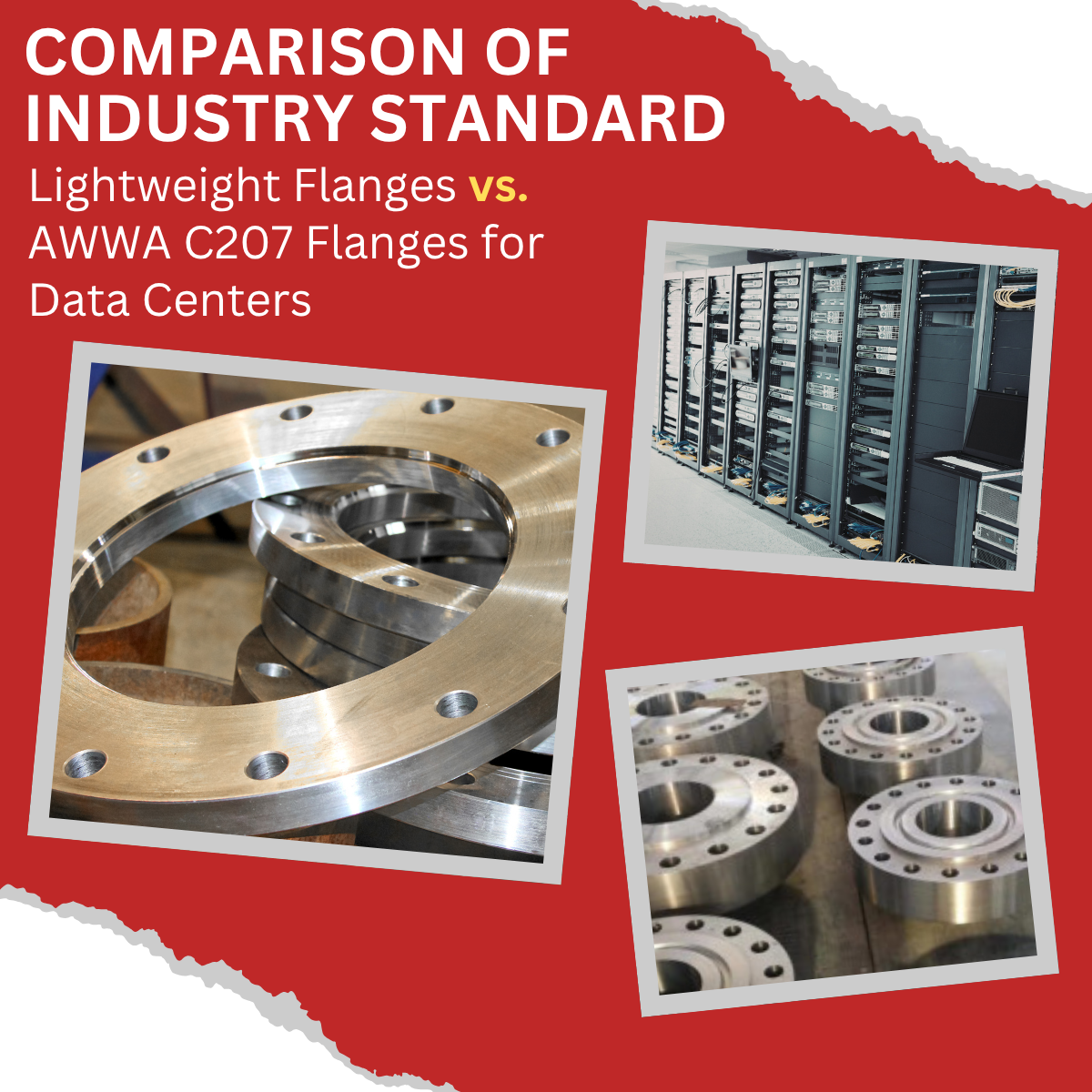
Lightweight vs AWWA C207 Flanges for AI Data Centers | Key Engineering Differences
In an AI data center, a minor leak can lead to terrible downtime. That’s why the choice between lightweight flanges and AWWA C207 flanges is a foundational engineering decision. Choosing the right flange standard ensures the best balance of reliability, cost, and performance.
Lightweight Flanges: Overview And Applications
This article will help consultants and procurement teams optimize their AI data center piping flanges.
Lightweight flanges, often referred to as slip-on or plate flanges, are engineered for efficiency and do not necessarily meet the heavy-duty thickness requirements of ASME B16.5. These components are designed to match the bolt patterns of standard classes but feature a thinner profile to reduce material volume.
Key Advantages
Reduced Weight: In large-scale data centers, reducing the dead load on structural supports is vital. Lightweight flanges are easier to handle during installation.
Cost Efficiency: These flanges offer a lower price point per unit.
Ease of Installation: Their lighter profile allows for faster alignment and welding.
Typical Applications and Limitations
Lightweight flanges are ideal for low-to-medium pressure systems. However, their thinner cross-sections mean they have lower resistance to flange rotation or warping under high bolt torque or thermal cycling.
AWWA C207 Flanges: Overview And Applications
AWWA C207 standard is specifically tailored for waterworks service. AWWA C207 flanges focus on the unique pressures and temperatures found in water transport.
Standards and Pressure Classes
AWWA C207 defines several classes (B, D, E, and F) based on pressure ratings ranging from 85 psi to 300 psi. These flanges are typically made from carbon steel and stainless steel, with galvanized, painted, or custom finishes but are designed with a larger safety factor for water hammer and surge pressures.
Why AWWA C207 For AI Data Centers?
These flanges are the workhorses of large-diameter water systems. Because AI data centers require massive volumes of water to move through primary headers, the AWWA C207 flange provides the structural rigidity needed for pipes. They are built to handle the vibration and constant flow of mission-critical infrastructure.
Critical Differences Between Lightweight And AWWA C207 Flanges
To select the right component, you need to understand the C207 vs lightweight flange differences.
Pressure Rating and Strength
While both can be rated for 150 psi, the AWWA C207 flange is generally thicker than a lightweight plate flange of the same nominal size. This thickness provides superior load-bearing capacity and prevents the flange face from bowing. In an AI data center, the ability to handle pressure surges is a major safety advantage.
Corrosion Resistance and Durability
AI cooling systems often use chemically treated water or glycol mixes to prevent scaling. Corrosion-resistant flanges are a must. AWWA C207 flanges are frequently provided with specialized coatings that meet stringent water-quality standards.
Lightweight flanges may require more rigorous third-party testing to ensure the material chemistry is up to the task of a 20-year lifespan.
Compatibility with AI Data Center Requirements
Lightweight flanges are suitable for non-critical paths or smaller diameter lines.
AWWA C207 flanges are preferred due to their reliability and ability to maintain a tight seal under the vibration of massive pumping stations.
Factors To Consider For AI Data Center Piping
When performing a flange comparison for water systems, engineers must evaluate beyond the pressure on a data sheet.
Water Quality: If the system uses gray water for cooling towers or highly deionized water for direct-to-chip cooling, the metallurgical purity of the flange is paramount.
Redundancy Needs: In data centers, every joint is a potential point of failure. The higher safety factor of AWWA C207 often justifies the cost in these high-redundancy environments.
Space Constraints: AI data centers are densely packed. While lightweight flanges save space and weight, they must not be used where mechanical stresses exceed their structural limits.
Cost vs. Performance Analysis
Short-Term vs. Long-Term Cost Implications
From a procurement standpoint, lightweight flanges win the initial bid. They are cheaper to ship and faster to hang. However, the hidden cost is the risk of a leak.
Lifecycle and Maintenance Trade-Offs
AWWA C207 flanges offer a longer lifecycle with fewer maintenance requirements. They are less likely to require re-torquing of bolts over time. When choosing between high-pressure flange selection options, the AWWA standard typically yields a lower Total Cost of Ownership because it minimizes the risk of emergency repairs.
Conclusion And Recommendations
The choice between AWWA C207 flanges and lightweight flanges for AI data center piping flanges depends on the specific zone of the cooling system.
Recommendation 1: For primary chilled water headers and large-diameter supply lines, specify AWWA C207 Class D or E flanges.
Recommendation 2: For secondary loops, low-pressure drainage, or smaller-diameter treated water lines, lightweight flanges provide an excellent opportunity.
In a nutshell, a thorough engineering evaluation of your flow rates, pressure surges, and vibration profiles will dictate the best path forward.
Need expert guidance on your next project? Consult with Sumitec’s experienced professionals to ensure your cooling infrastructure is built to last. Call us today for more details.